
Learn how AI powered flexi benefits, tax efficient salary structuring, and payroll-embedded device leasing help Indian employees save ₹8,000–15,000/month, without increasing the CTC.

Picture your most talented engineer. She earns ₹18 lakh a year, lives in Whitefield, orders groceries on Instamart, pays for fuel every week, and eats lunch at the office cafeteria. By every conventional measure, she is well compensated. And yet, at the end of the financial year, she quietly hands over anywhere between ₹2–4 lakh more in taxes than she needs to.
This doesn't happen because she's making poor financial decisions. It happens because her salary is structured inefficiently. Nobody in her company told her that structure, not salary level, is what's quietly draining her take home pay every month.
This is not a story about tax evasion. It is a story about structural negligence, and with India's most significant salary reform in six decades, the Income Tax Act 2025, effective April 1, 2026, it has become an urgent one.
India's HR departments have spent decades perfecting the CTC slide: a beautifully formatted document listing PF, gratuity, insurance, and a long tail of allowances. It looks comprehensive. It rarely is.
The core problem is not that salaries are too low. It is that salaries are designed too simply. A significant portion of most employees' income ends up fully taxable, even when legitimate, legally recognised mechanisms exist to structure it otherwise.
The result is consistent across organisations: employees take home less than they should, benefits that were designed to help them remain underutilised, HR teams spend disproportionate time managing manual claims, and finance teams struggle with growing compliance complexity.
Under the new Income Tax Rules 2026, the problem has deepened further. Perquisites, reimbursements, and allowances are now valued under fundamentally redefined norms. Companies that haven't revisited their flexible benefit plan (FBP) in light of these changes may be inadvertently increasing their employees' taxable income, without changing their CTC by a single rupee.
A flexible benefit plan, also called an FBP or cafeteria-style benefit plan, is a component of an employee's CTC that is structured as tax-exempt allowances rather than taxable salary. By allocating a portion of pre-tax CTC toward eligible categories, employees legally reduce their taxable income and receive a higher in-hand salary, without any change to the employer's total payroll outlay.
Key flexi benefit categories under Indian tax law include:
The logic is straightforward: the money already exists inside the CTC. The only question is whether it reaches the employee's wallet, or disappears into the tax machinery.
Under the IT Act 2025, several of these perquisites now carry clearly revised valuation norms, which makes it more important than ever for employers to architect salary components correctly, and for employees to actually use the benefits available to them.
Most organisations that offer flexi benefits rely on systems that require employees to decide allocations months in advance, submit claims manually, and wait for reimbursements. The process is time-consuming, confusing to navigate, and easy to abandon.
The outcomes are predictable: low adoption, incomplete utilisation, and benefits that exist on paper but rarely in practice. HR teams end up managing fragmented workflows, spreadsheets here, a portal there, a reimbursement email thread somewhere else, while finance teams reconcile data across systems at quarter-end. The compliance tail is long, the audit trail is thin, and the employee feels none of the benefit that was designed for them.
A system designed to improve financial wellness becomes one that most people quietly ignore.
The more sophisticated answer to benefit underutilisation is not a better portal. It is intelligence embedded directly into the payroll layer, removing friction from a process employees find genuinely confusing.
AI-powered flexi benefits work differently. Instead of asking employees to adapt to the system, the system adapts to how employees actually spend. Every UPI transaction is captured and classified in real time, fuel, food, fitness, medical, and mapped automatically to the corresponding tax exempt FBP salary component. The impact appears in the same month's salary. No manual claims. No waiting.
The compliance picture changes too. Every transaction is documented at the point of occurrence, creating a clean, verifiable audit trail that directly addresses the tightened perquisite valuation and documentation requirements under the Income Tax Rules 2026. Compliance becomes an inherent feature of the system, not a process bolted on at quarter-end.
For finance teams, working capital blocked in reimbursement cycles is released. For HR, operational overhead drops. For the employee, take home pay increases by ₹8,000–15,000 per month, without a single additional rupee added to payroll.
The power of salary structuring becomes even clearer with a concrete example.
Your employee needs a laptop. The company won't buy it, it's not in the asset budget. He visits a consumer electronics store, swipes his credit card, and pays ₹2,800 per month from post-tax salary. No GST benefit. No income tax saving. Just a credit card bill.
Now consider the alternative. Through payroll embedded device leasing, the same laptop is structured within his salary as a tax-efficient benefit. He accesses a premium device with zero upfront cost. The income tax saving reduces his effective cost by approximately 30%. The employer claims an 18% GST input credit. The company carries zero asset liability and zero HR management overhead.
The net outcome: the same device costs approximately 40% less than an outright purchase, not because the price changed, but because the structure did.
Employee retention is typically addressed through salary increases, bonuses, or perks. These matter. But they don't fully explain why talented people leave or stay.
An employee who consistently takes home more money, without any change in CTC, experiences a meaningfully different financial reality. That difference compounds month after month. It builds trust in the employer. It reduces financial stress. And it creates a form of loyalty that a one-time counter-offer struggles to match.
In Bengaluru, Hyderabad, Gurgaon, and Pune, where the competition for skilled talent is sharpest, the total financial experience is increasingly what separates employers. A company that can demonstrate, through a live dashboard, that its employees take home ₹8,000–15,000 more per month than they would at a competitor has an employee retention argument that no incremental salary hike easily erases.
The financial pressure on India's salaried workforce is real. But a significant part of it is self inflicted, the result of static compensation structures that haven't kept pace with what the tax code actually permits.
When salaries are designed more intelligently, employees retain more of what they earn. Companies deliver more value without increasing costs. And the employer-employee relationship is built on something more durable than the next appraisal cycle.
The Income Tax Act 2025 has raised the stakes. The organisations that move quickly to redesign compensation, with real-time intelligence, compliance built into the transaction layer, and benefits that actually reach the people they were designed for, will be meaningfully better positioned to attract and retain the talent that everything else depends on.
The money is already in the CTC. The question is whether your salary structure is letting employees keep it.

SalarySe raises $11.3M to redefine credit access for India’s workforce. Led by Flourish Ventures and SIG Venture Capital, with support from Peak XV Partners and Pravega Ventures, the funding will fuel AI-led innovation, enterprise expansion, and smarter financial solutions for salaried professionals.

What organisations are calling quiet quitting is often financial anxiety presenting as disengagement. Smart employers are addressing the root cause, not the symptom.
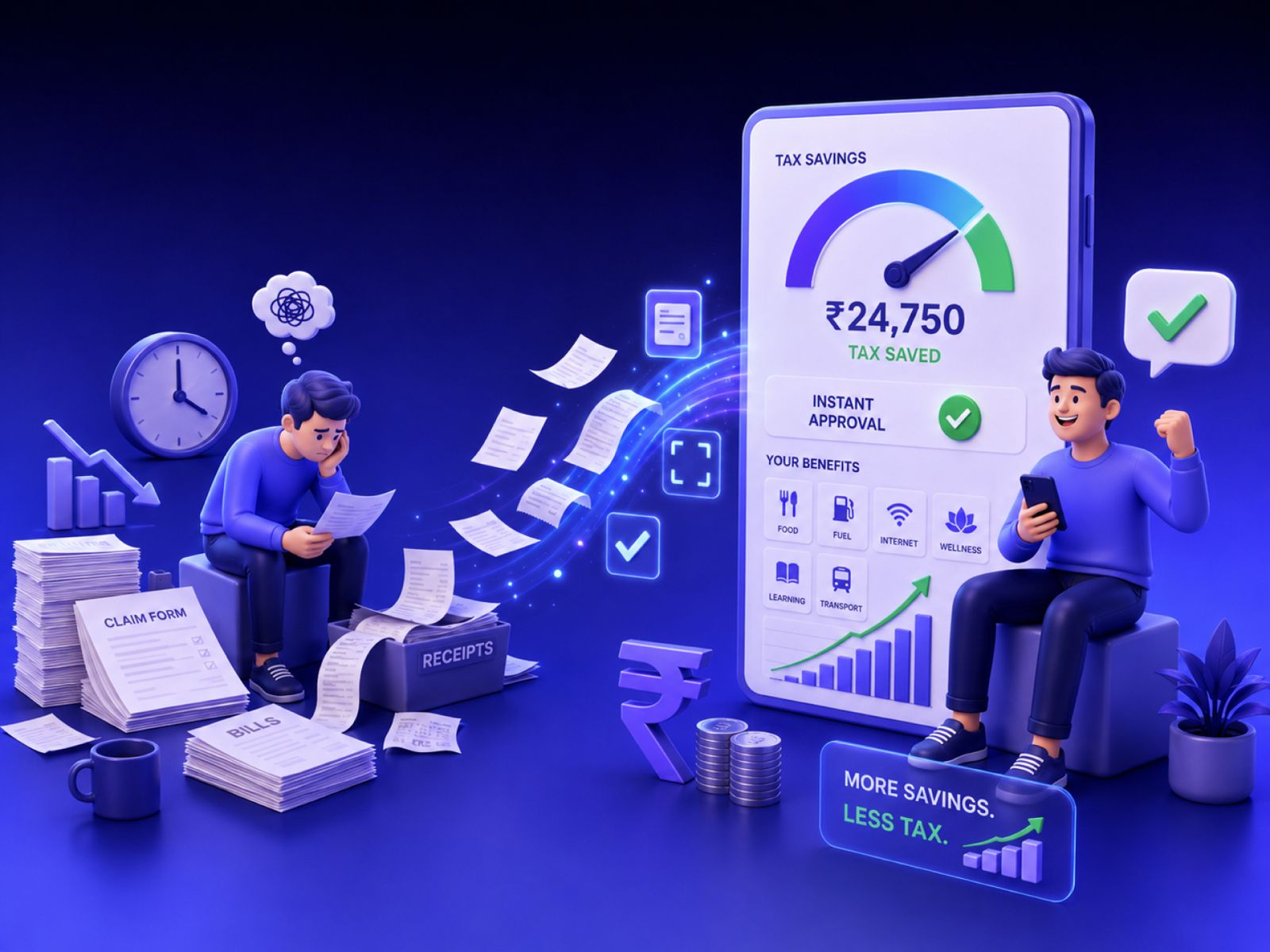
India's employee Benefits landscape is shifting from slow, manual reimbursements to intelligent, real-time tax savings, and forward-thinking HR leaders are already making the switch.