
Learn why your CIBIL score drops despite timely payments. Discover 8 hidden mistakes affecting your credit health and how to fix them to improve your score and secure better loan rates.
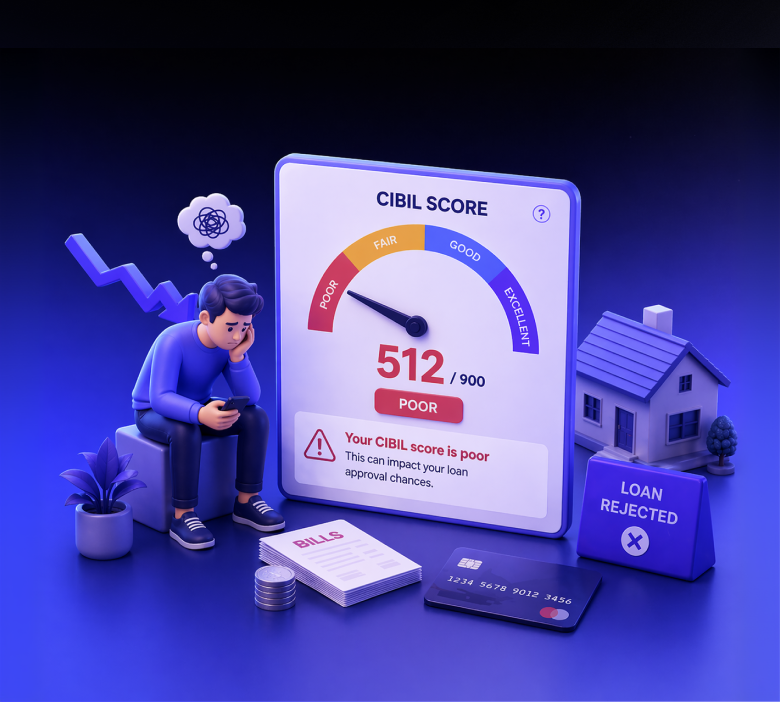
You checked your CIBIL score and it's lower than you expected. You haven't missed an EMI. You haven't defaulted on a loan. So what went wrong?
This is the experience of thousands of salaried Indians every year, and the frustrating part is that most of the damage happens quietly, through habits that seem completely harmless. A score you assume is healthy can be silently eroding for months before you notice.
Your CIBIL score (officially called the TransUnion CIBIL score) is a three-digit number between 300 and 900 that lenders use to decide whether to give you credit, and at what interest rate. Anything above 750 is generally considered good. But maintaining that number takes more than just paying your bills on time. There are hidden landmines that most people don't know about until the damage is done.
Here are the ones that hurt the most.
This one feels responsible. You got the bill, you made a payment, you avoided a late fee. But the minimum due trap is one of the most damaging habits for your credit health, and it works in two ways.
First, the unpaid balance keeps accumulating interest, sometimes at 36–42% per year. Second, and less obviously, your credit utilisation ratio, which is how much of your available credit limit you're using stays high. Lenders and credit bureaus treat high utilisation as a red flag. A person using 80% of their credit limit looks financially stretched, even if they're technically "paying" every month.
The target most experts recommend is staying below 30% of your total credit limit at all times. If your card limit is ₹1 lakh, try to never let your outstanding balance cross ₹30,000.
Every time you apply for a credit card, a personal loan, or even a "pre-approved" offer, the lender makes what's called a hard inquiry on your credit report. Each hard inquiry can shave a few points off your score. One or two is fine. But if you applied to five lenders in the same month, maybe because you were shopping around for the best deal, that cluster of inquiries signals desperation or financial distress to future lenders.
The frustrating part is that you might not even have taken the credit. Just applying is enough to leave a mark.
The fix is simple: research thoroughly before you apply, and apply to one lender at a time. When you do decide to get a credit card, choosing one that's designed for your actual income level and spending pattern means you're less likely to need to upgrade or switch cards frequently.
Closing a credit card you don't use anymore seems like good financial hygiene. In reality, it can hurt your score in two ways.
The first is credit age. Your CIBIL score takes the average age of all your credit accounts into account. If you close a card you've had for seven years, that long history disappears from the average, and your score can drop.
The second is credit utilisation, again. Closing a card reduces your total available credit limit. If your spending stays the same, your utilisation ratio goes up automatically, even though you haven't spent a single rupee more.
Unless a card has a high annual fee that isn't worth it, keeping older cards open (even if you barely use them) is usually the smarter move.
This one surprises people. If you've always paid cash, never taken a loan, and never owned a credit card, you might assume you have a perfect financial record. In credit bureau terms, you're essentially invisible.
A thin credit file, one with very little credit history, can actually make it harder to get approved for a home loan or a car loan when you need one, because lenders have no evidence of how you handle borrowed money. Some people in this situation find they're offered worse interest rates than someone with a moderate history and a few small blemishes.
Building credit doesn't mean going into debt. A basic credit card used for everyday purchases, petrol, groceries, subscriptions, and paid off in full every month is enough to establish a healthy track record. The key is consistency over time.
For salaried professionals looking to start that journey, a card like the SalarySe LevelUP Credit Card is worth considering. It's built around the rhythm of a monthly salary, rewarding you most on and around payday, when you naturally spend the most, and can help you build a consistent credit history without needing to change your spending habits.
Here's a nuance that almost nobody talks about: credit bureaus don't necessarily look at your utilisation based on what you owe at the end of the month. They often look at what's on your statement when it's generated, which is usually your billing cycle date, not your payment due date.
So even if you pay your bill in full every single month, if you made a large purchase right before the statement date and your balance is temporarily high, that's what gets reported. Your utilisation looks high on paper, even though you had every intention of clearing it.
The workaround is to either make a mid-cycle payment before the statement is generated, or to request a credit limit increase so that the same spending represents a smaller percentage of your available credit.
When you co-sign a loan for a family member or friend, a sibling's education loan, a parent's vehicle loan, that debt appears on your credit report too. If they miss payments, your score takes the hit alongside theirs.
This is one of the most emotionally difficult CIBIL problems to deal with because it combines family relationships with financial consequences. Before co-signing anything, make sure you're genuinely comfortable absorbing the risk if the other person can't pay.
A significant number of people have errors on their credit report, a loan that's been repaid but still shows as outstanding, a hard inquiry from a lender you never approached, or a wrong PAN association. These errors can quietly drag your score down for years.
The good news is that checking your own credit report is free (once a year from CIBIL directly) and doesn't affect your score at all, that's a soft inquiry, not a hard one. It's worth doing at least once a year, especially before you apply for any significant credit.
If you find an error, you can raise a dispute directly on the CIBIL website. It takes some persistence, but errors do get corrected.
If you ever negotiated a settlement with a bank, where they agreed to accept a lower amount than what you owed in exchange for closing the account, that settlement is recorded on your credit report as "settled" rather than "closed."
To most lenders, "settled" is a yellow flag. It means you didn't repay the full amount you borrowed. While it's certainly better than a default, it can still make lenders cautious about extending you credit, sometimes for years.
Wherever possible, try to clear the full outstanding amount even if it means taking more time. A "closed" status is always cleaner than a "settled" one.
Your CIBIL score is like your financial reputation, built slowly over time and damaged faster than most people expect. The good news is that most of these mistakes are reversible. A score that's dropped can recover, usually within 12 to 24 months of consistent, responsible credit behaviour.
The most important habits are simple: keep your utilisation below 30%, pay the full amount (not just the minimum) wherever possible, avoid unnecessary hard inquiries, and check your credit report at least once a year.
If you're building credit from scratch or trying to improve an existing score, the way you use your credit card day-to-day matters more than any single decision. Spending within your means, paying on time, and choosing a card that actually rewards the way you spend, rather than one designed for a lifestyle you don't have, makes the process feel a lot less like discipline and a lot more like common sense.


SalarySe raises $11.3M to redefine credit access for India’s workforce. Led by Flourish Ventures and SIG Venture Capital, with support from Peak XV Partners and Pravega Ventures, the funding will fuel AI-led innovation, enterprise expansion, and smarter financial solutions for salaried professionals.
Compare salary advance apps in India: loan amounts, interest rates, approval times, RBI-regulated options, and eligibility criteria for salaried employees.
Compare instant salary loans online: funding in 15 minutes to 2 seconds, loan amounts ₹5,000, ₹1 lakh, approval requirements, and interest rates across…